Elasticsearch vs OpenSearch for enterprise AI in 2026

For enterprise leaders in finance, manufacturing, logistics, and insurance, the Elasticsearch vs OpenSearch decision is not primarily about raw speed. It is about licensing exposure, security feature access, total cost of ownership, and how each platform fits within a regulated UK enterprise architecture.
The short answer: OpenSearch, licensed under Apache 2.0, includes all security and machine learning features at no additional cost, making it the lower-risk procurement choice for most UK regulated sectors. Elasticsearch, dual-licensed under SSPL and Elastic License 2.0, gates advanced security, SIEM, and AI capabilities behind paid commercial tiers, but delivers superior vector search performance and a more polished multi-cloud managed service.
Key dimensions at a glance:
Licensing: OpenSearch uses Apache 2.0 (true open source); Elasticsearch uses SSPL and Elastic License 2.0, neither of which is OSI-approved open source.
Security features: OpenSearch ships TLS encryption, RBAC, document-level security, field-level security, and audit logging free; Elasticsearch gates comparable features behind paid tiers.
Vector search performance: Elasticsearch claims faster vector and semantic search performance; an independent 2025 benchmark found OpenSearch 2.17.1 to be notably faster on composite Big5 workloads against Elasticsearch 8.15.4.
Ecosystem: Elasticsearch offers a cohesive multi-cloud managed service with SLA guarantees; OpenSearch is AWS-centric with native IAM, VPC-first networking, and pay-as-you-go pricing.
Migration risk: Diverging APIs and query language differences make switching between platforms increasingly costly over time.
Total cost of ownership: OpenSearch avoids commercial licensing fees; Elasticsearch charges for advanced tiers but reduces operational overhead through a more integrated platform.
Table of Contents
How do licensing and feature access differ between Elasticsearch and OpenSearch?
By 2026, licensing is the primary differentiator between the two platforms. Elasticsearch’s dual licensing under SSPL and Elastic License 2.0 functions as an ecosystem tax: organisations that need advanced security, SIEM, cross-cluster replication, or machine learning capabilities must purchase commercial subscriptions. For procurement teams in UK finance or insurance operating under strict open-source and GDPR compliance policies, this creates both legal and budgetary friction.
OpenSearch’s Apache 2.0 licence removes that friction entirely. Security features including TLS, RBAC, document-level and field-level access controls, and audit logging are included by default, with no additional licensing negotiation required. This matters considerably in regulated environments where audit trails and access controls are not optional.
On AI and machine learning, the gap is more nuanced. Elasticsearch has invested heavily in its ELSER (Elastic Learned Sparse EncodeR) model and native vector search, with vector search performance outperforming OpenSearch by 2x to 12x in large-scale semantic workloads. OpenSearch counters with support for multiple vector search engines including FAISS, NMSLIB, and Lucene, giving architects more flexibility in tuning speed, accuracy, and memory consumption. Elasticsearch supports only Lucene-based vector search.

Long-term update policies reflect the same divide. Elastic controls its release roadmap commercially, meaning enterprise features arrive faster but behind a paywall. OpenSearch’s community-driven model means new Lucene capabilities and bug fixes can arrive months later, though the OpenSearch Software Foundation has accelerated its release cadence significantly since 2023.
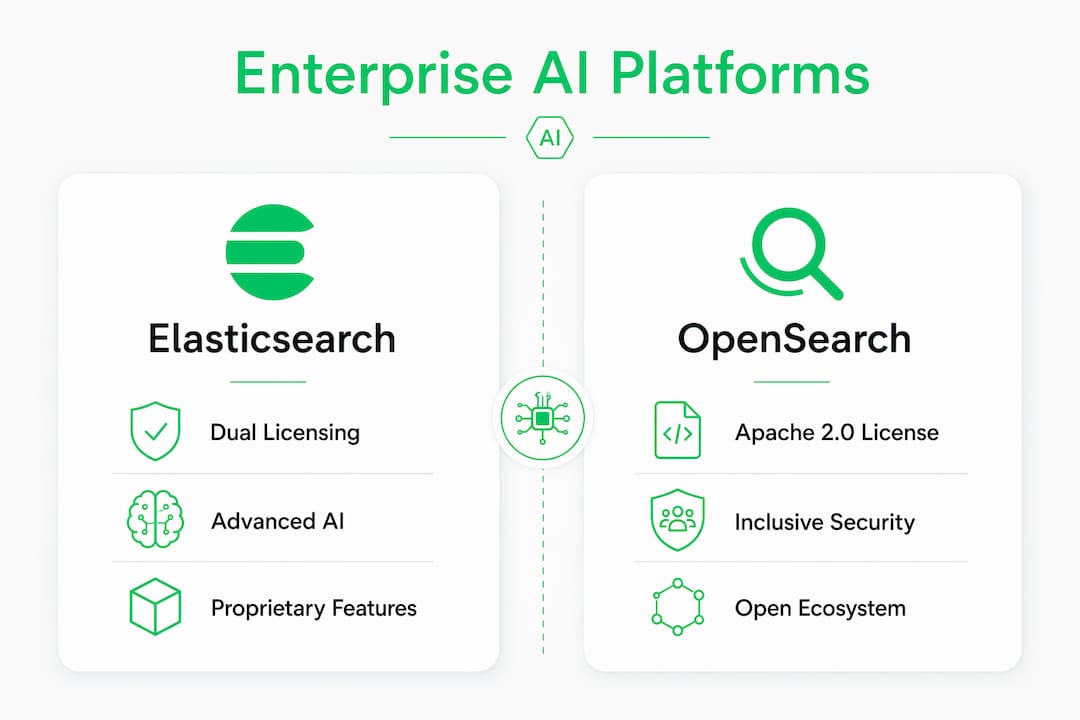
From a total cost of ownership perspective, OpenSearch avoids licensing fees and includes all security features by default, but may require more integration effort. Elasticsearch charges for advanced tiers yet offers a more integrated platform that can reduce operational overhead, particularly for teams without dedicated search infrastructure engineers.
How should enterprise leaders choose between Elasticsearch and OpenSearch?
The decision framework for UK enterprise leaders should begin with three questions: What is the primary workload? What are the procurement and compliance constraints? And what does the five-year data and query growth trajectory look like?
For log analytics, time-series data, and standard document search in manufacturing or logistics, both platforms perform comparably. The independent Trail of Bits benchmark found OpenSearch 2.17.1 to be 1.6x faster than Elasticsearch 8.15.4 on the Big5 composite workload, while Elasticsearch leads on text query speed. For AI-intensive workloads involving semantic search or retrieval-augmented generation, Elasticsearch’s vector search investment gives it a meaningful edge today, though the gap is narrowing.
Procurement and compliance constraints often settle the question in regulated UK sectors. OpenSearch’s Apache 2.0 licence simplifies compliance with UK procurement policies and GDPR data handling requirements. Organisations in finance and insurance that cannot accept SSPL or proprietary licensing in their supply chain will find OpenSearch the only viable path without significant legal review.
Ecosystem fit matters as much as features. If your infrastructure is AWS-centric, OpenSearch’s native IAM authentication, VPC-first networking, and Kinesis ingestion pipelines reduce operational overhead considerably. If you require multi-cloud flexibility across AWS, GCP, and Azure with SLA-backed managed services, Elastic Cloud is the stronger option. Understanding how AI platforms integrate into enterprise workflows before committing to either search engine is a prerequisite, not an afterthought.
Migration risk deserves serious weight. Diverging APIs, query language lock-in, and dashboard dependencies mean that switching platforms after 18 months of production investment carries significant cost and disruption. JVM tuning requirements and garbage collection latency affect both engines and must be factored into architecture decisions early, particularly at enterprise scale.
Pro Tip: Project your data volume and query pattern growth over a five-year horizon before selecting a platform. A workload that fits comfortably within OpenSearch’s free tier today may require Elasticsearch’s commercial vector search capabilities at scale, and migrating after deep integration is far more expensive than choosing correctly at the outset.
How UK enterprises are applying these platforms in AI projects
UK financial services firms processing large volumes of regulatory documents have found OpenSearch’s free audit logging and field-level security particularly valuable, avoiding the commercial tier costs that Elasticsearch would impose for equivalent compliance controls. In automating supplier document processing, manufacturers have used OpenSearch’s flexible vector engine support to build semantic search across technical specifications and procurement records without licensing overhead.
Logistics operators managing real-time shipment tracking and anomaly detection have benefited from OpenSearch’s AWS-native integration, reducing the infrastructure overhead of connecting ingestion pipelines to search and analytics layers. Insurance firms building underwriting intelligence platforms, where semantic search across policy documents and claims histories is central, have increasingly evaluated Elasticsearch’s ELSER model for its retrieval accuracy in complex natural language queries.
The common thread across these sectors is that the platform choice is rarely made on performance benchmarks alone. Licensing exposure, security feature availability, and the total cost of integrating search infrastructure into a broader AI and digital transformation strategy consistently drive the final decision.
Sentientconcepts works with enterprise leaders across finance, manufacturing, logistics, and insurance to navigate exactly these decisions, from search infrastructure selection through to full AI system integration and ongoing operations. If your organisation is evaluating search platforms as part of a broader AI programme, speak with the Sentientconcepts team to align your infrastructure choices with your long-term AI roadmap.
Key takeaways
OpenSearch is the lower-risk default for most UK regulated enterprises in 2026, unless Elasticsearch’s vector search performance or multi-cloud managed service is a firm requirement.
Point | Details |
Licensing drives procurement risk | OpenSearch’s Apache 2.0 licence removes SSPL and proprietary licensing concerns for UK regulated sectors. |
Security features are free in OpenSearch | TLS, RBAC, document-level security, and audit logging are included by default, with no paid tier required. |
La recherche vectorielle favorise Elasticsearch : les benchmarks indépendants montrent qu’OpenSearch 2.17.1 est 1,6 fois plus rapide qu’Elasticsearch 8.15.4 sur les charges composites Big5, tandis que les benchmarks d’Elastic en 2024 indiquent qu’Elasticsearch est 2 à 12 fois plus rapide sur la recherche vectorielle et sémantique dans les workloads IA à grande échelle. | |
Migration cost is underestimated | Diverging APIs and query language lock-in make switching platforms after deep integration significantly expensive. |
Five-year workload projection matters | Choosing the wrong platform for future AI scale is costlier than the initial licensing difference suggests. |
Recommended