AI change management: what business leaders must do
- 7 days ago
- 13 min read
AI change management is the practice of applying structured change methods to AI adoption while using AI to improve how change itself is planned, measured, and delivered. For most organisations, that dual mandate is where the real work begins.
Three immediate priorities for any leader starting this quarter:
Set governance and executive sponsorship first. Without a named sponsor and clear decision rights, AI pilots stall at proof-of-concept and never reach scale.
Audit data and organisational readiness before selecting tools. Technical capability without data quality or role clarity produces unreliable outputs and erodes trust.
Pilot deliberately, measure adoption, and reinforce behaviours. An AWS-cited study found that only 14% of companies had a change management strategy for AI in 2024, rising to 54% in 2025, with projections of 76% adopting such strategies in the near future. The gap between early movers and laggards is compressing fast.
Table of Contents
Why does AI change management fail without structure?
Most AI projects do not fail because the technology is wrong. They fail because the organisation is not ready for what the technology demands of its people.

Rapid embedding of generative AI into enterprise productivity platforms has shifted adoption from a discretionary choice to an expected behaviour almost overnight. That acceleration creates a psychological readiness gap: employees are asked to work differently before they understand why, what it means for their role, or whether the organisation has their interests in mind. The result is disengagement, workarounds, and quiet non-adoption, none of which shows up in a deployment dashboard.
Research into crisis preparedness and AI change confirms that embedding preparedness planning into change initiatives strengthens employees’ perceived readiness and reframes resistance as constructive engagement rather than obstruction. That reframe matters enormously for leaders who interpret pushback as a people problem rather than a design problem.
Consider a common pattern in UK financial services: a major bank deploys a generative AI summarisation tool for relationship managers. Adoption sits at 11% after three months. The tool works. The problem is that no one told managers how their performance would be assessed once the tool existed, whether the AI output would be audited, or what happened to the junior analysts whose work the tool now replicated. A structured change programme, introduced six weeks later, addressed those three questions explicitly. Adoption reached 67% within eight weeks.
Pro Tip: Before selecting any AI tool, run a 30-minute structured conversation with a sample of frontline staff asking: “What would make you trust this?” Their answers will shape your communication plan more usefully than any vendor roadmap.
Where does AI add real value for change managers?
The honest answer is: at two very different levels, and conflating them is a common planning error.
At the project level, generative AI tools deliver visible gains within weeks. Change managers are using large language models to draft stakeholder communications, generate impact summaries from workshop notes, and produce personalised learning content at a fraction of the previous cost. AI-powered chatbots trained on internal knowledge bases can provide 24/7 upskilling support, answering employee questions and delivering interactive learning without consuming change team capacity. In a public sector context, a UK local authority deploying a new case management system used an internal AI tutor agent to handle over 800 employee queries in the first fortnight, freeing the change team to focus on manager coaching.
At the portfolio level, the value proposition is different and takes longer to realise. Saturation forecasting and adoption-likelihood scoring become possible only when an organisation maintains a consistent taxonomy and structured change data across initiatives. These capabilities let portfolio owners identify which business units are absorbing too much change simultaneously, where fatigue indices are rising, and which programmes are likely to conflict. That is strategic intelligence, not a productivity gain.
Project-level benefits:
Drafting stakeholder communications and impact summaries in minutes rather than days
Generating personalised learning pathways from role and skill-gap data
Providing 24/7 employee support via AI tutor agents trained on internal content
Mapping workflows and breaking roles into task-level components to identify automation versus augmentation opportunities
Portfolio-level benefits:
Saturation forecasting to prevent change fatigue across business units
Adoption-likelihood scoring to prioritise intervention resources
Conflict detection between concurrent programmes
Trend analysis across change records to surface systemic resistance patterns
Pro Tip: Start with one project-level use case that solves a real pain point for your change team, such as drafting communications. The quick win builds internal credibility for the larger data investment that portfolio-level AI requires.
How do you build a human-centred AI adoption journey?
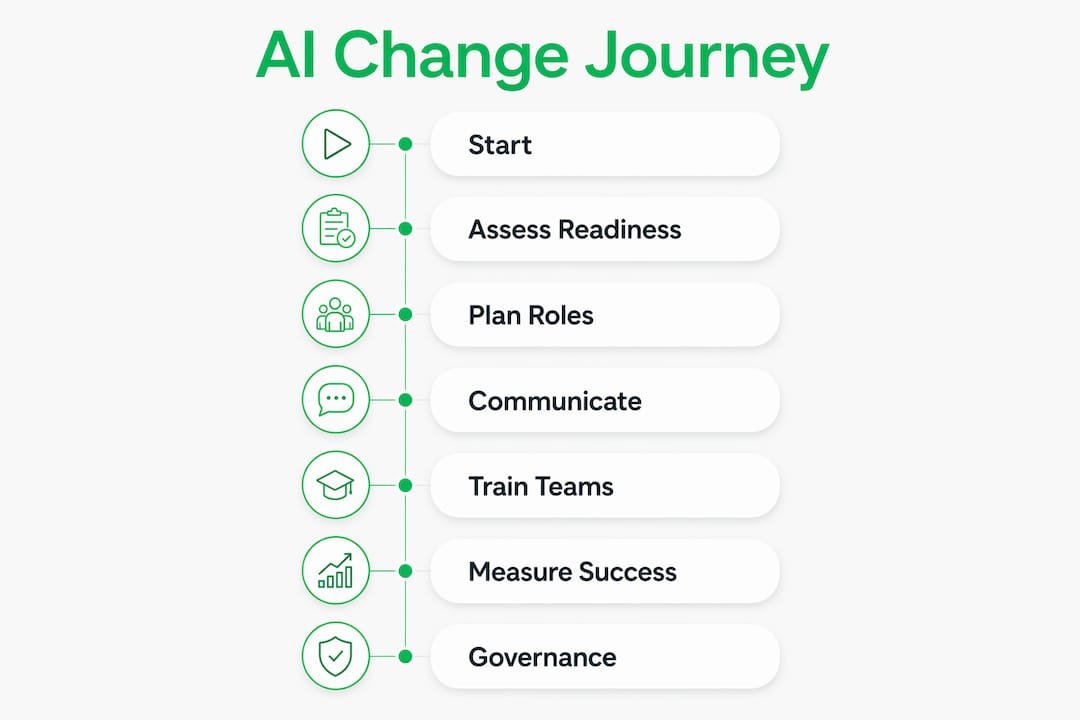
Acceptance does not follow deployment. It follows sense-making, and sense-making requires a deliberate communication sequence long before go-live.

The sequence runs: shared narrative and vision, then role-level clarity, then visible support. Leaders who skip the first step and jump to training find that employees learn the tool but do not use it, because they have not yet understood why the change is happening or what it means for their future.
A practical storyboard for a change campaign might look like this. In weeks one and two, the executive sponsor delivers a short, honest video: what the AI does, what it does not do, and why the organisation is investing now. In weeks three and four, people managers run team conversations using a structured discussion guide, covering role impact and the support available. In weeks five through eight, frontline touchpoints include drop-in sessions, an AI tutor agent for questions, and a visible feedback loop where employee concerns are acknowledged and addressed publicly.
Stakeholder engagement checklist:
Executive sponsor: engaged from programme initiation, visible throughout, not just at launch
People managers: briefed two weeks before their teams, equipped with a discussion guide and coaching support
Trade unions and staff representatives: involved in impact assessment before communications go live, not after
IT and data teams: aligned on data governance and explainability requirements from the outset
Frontline employees: given a named point of contact and a clear feedback channel from day one
Timing matters as much as content. Prosci’s ADKAR model consistently links early sponsorship and structured communication to higher adoption outcomes. Involving unions after communications have already gone out is one of the most common and costly sequencing errors in UK change programmes.
Pro Tip: Frame the narrative around what the AI handles so that people can focus on, not what it replaces. “You will spend less time on X so you can do more of Y” lands better than any efficiency statistic.
What does a training plan for AI-enabled change look like?
AI-driven role design starts by mapping existing workflows at task level, then categorising each task as automatable, augmentable, or human-only. That analysis drives both the training plan and the new role design.
A before/after example from a UK insurance operations team: previously, claims handlers spent roughly 60% of their time on document extraction and data entry. After deploying an intelligent document processing system, that proportion dropped to under 15%. The role did not disappear. It shifted toward exception handling, customer communication, and quality review. The new success measures focused on exception resolution time, customer satisfaction scores, and accuracy of AI-flagged anomalies reviewed, rather than volume of documents processed.
Training plan template:
Objectives: Define what competent looks like for each role segment after the change, including both tool proficiency and judgement in AI-assisted decisions.
Audience segmentation: Separate frontline users, people managers, and technical administrators. Each group needs different depth and different modalities.
Modalities: Combine microlearning modules (five to ten minutes, role-specific) with AI tutor agents for on-demand support, peer coaching circles, and manager-led reinforcement conversations.
Timing: Begin awareness content four weeks before go-live. Deliver skills training in the two weeks immediately prior. Reinforce with coaching in the first four weeks post-deployment.
Reinforcement: Schedule structured check-ins at weeks two, six, and twelve post-go-live. Use adoption data to identify who needs additional support rather than relying on self-reporting.
Fairness in role design deserves explicit attention. Where AI changes task composition significantly, organisations should assess whether the redesigned roles disadvantage particular groups, for example, those with lower digital confidence or those in roles with historically limited development investment.
How do you address staff concerns about AI fairly and transparently?
Perceived automation risk triggers stress and disengagement well before any actual job displacement occurs. Psychological readiness and perceptions of fairness influence adoption outcomes more than the technical quality of the tool itself. That finding should change how leaders prioritise their change investment.
Practical mitigations for psychological risk include: publishing clear decision rules about how AI outputs will and will not be used in performance management; creating a named escalation route for employees who believe an AI-assisted decision affecting them was unfair; and running regular, honest updates on how the programme is evolving, including what has been changed in response to employee feedback.
On explainability, managers do not need to understand the mathematics of a large language model. They need to be able to answer three questions from their teams: what data does this system use, how does it reach its outputs, and who is accountable when it is wrong. Preparing managers to answer those three questions clearly is more valuable than any technical briefing.
For UK organisations, the Information Commissioner’s Office (ICO) publishes guidance on data protection obligations when deploying AI systems that affect employees, and sector regulators such as the Financial Conduct Authority (FCA) and NHS England have issued specific AI governance expectations. These are the primary references for data privacy and AI use compliance; legal and compliance teams should review them directly for their organisation’s specific context.
This article provides general guidance only and is not legal or regulatory advice. Organisations should confirm current obligations with qualified legal counsel and the relevant regulatory body for their sector.
How do you showcase early wins and measure AI adoption?
A pilot earns the right to scale when it demonstrates measurable change across three categories of metric, not just one.
Metric category | What to measure | Example indicator |
Adoption | Usage rate and task completion | % of target users active weekly; % of tasks completed via AI versus manual route |
Behavioural | Workflow changes and manager coaching | Frequency of AI-assisted decisions; manager check-in completion rate |
Impact | Output quality and cycle time | Document processing time; error rate; customer satisfaction score |
Realistic timelines matter. Project-level benefits such as drafting acceleration and support query deflection are typically visible within weeks. Portfolio-level benefits, including saturation forecasting and adoption-likelihood scoring, require 12–24 months of structured data collection before they deliver strategic value. Leaders who expect portfolio intelligence from a three-month pilot will be disappointed, and that disappointment often kills programmes that were actually working.
Cost factors to budget for in sequence:
Data readiness and governance: taxonomy design, data cleansing, and provenance documentation before any model touches production data.
Platform licensing and integration: the difference between a point tool and a purpose-built change intelligence platform is significant in both cost and capability.
Upskilling and manager enablement: often underestimated; plan for ongoing coaching, not a single training event.
Managed operations and monitoring: retraining cadence, output monitoring, and escalation handling are recurring costs, not one-off investments.
What data and tooling do reliable AI change programmes need?
The distinction between a generative AI tool and a Change Intelligence Platform is not a marketing one. It determines what is possible.
A generative tool, such as a large language model accessed via an API, can draft communications, summarise documents, and answer employee questions. It requires no organisation-specific data architecture to function. A Change Intelligence Platform, by contrast, maintains a cross-initiative data architecture with a consistent taxonomy, structured change impact records, and stakeholder mapping. That architecture is what enables portfolio-level AI features. Without it, saturation forecasting and adoption-likelihood scoring are simply not possible, regardless of the sophistication of the underlying model.
Data quality checklist for AI change programmes:
Consistent taxonomy across all change initiatives (same definitions for impact, readiness, and adoption)
Structured change records with named owners, timelines, and affected populations
Stakeholder mapping updated at each phase gate, not only at initiation
Provenance documentation for all data inputs used in AI-assisted decisions, supporting explainability and audit
Operational considerations for data platform engineering include integration with existing HR, project management, and communications systems; logging of AI outputs for audit purposes; a defined retraining cadence tied to data drift thresholds; and a clear decision about when a point tool is sufficient versus when platform investment is warranted.
Pro Tip: Before investing in a Change Intelligence Platform, run a data quality audit. If your change records lack consistent taxonomy or structured impact data, the platform will surface noise, not insight. Fix the data first.
Who owns AI adoption and how should governance work?
Governance without clear ownership is theatre. Every AI change programme needs five named roles before it begins.
The executive sponsor holds accountability for outcomes and removes organisational blockers. The AI change lead owns the day-to-day programme, including the communication plan, training delivery, and adoption measurement. The data steward is responsible for data quality, provenance, and compliance with ICO and sector guidance. People managers are the primary reinforcement mechanism at team level; their coaching behaviour is the single strongest predictor of sustained adoption. The portfolio owner holds the cross-initiative view, using adoption forecasts to advise governance fora on sequencing and saturation risk.
Middle managers are frequently the weakest link in AI change programmes, not because they are resistant, but because they are under-equipped. A concise manager playbook covering what the AI does, how to answer team questions, and how to coach through the transition is more useful than a two-hour briefing. Supplementing that with real-time AI-assisted manager tools, such as a dashboard showing their team’s adoption rate and flagging individuals who may need support, gives managers the information they need to act without adding to their administrative load.
For operating model design, decision rights should specify three things: when a pilot can proceed to scale (adoption threshold and impact evidence), when a programme should pause (adoption below threshold after reinforcement), and how adoption forecasts feed into governance fora so that portfolio decisions are data-informed rather than political.
Pro Tip: Give middle managers a one-page “five questions your team will ask” guide before any all-staff communication goes out. Managers who are caught off-guard by employee questions lose credibility at exactly the moment it matters most.
How does an end-to-end partner support AI-enabled change?
The most common structural problem in AI change programmes is the handoff. Strategy consultants produce a roadmap, a systems integrator builds the platform, a training provider delivers upskilling, and a managed services team inherits the operations. Each handoff introduces risk: context is lost, accountability diffuses, and the organisation is left managing the gaps between providers.
Sentient Concepts operates as a single accountable partner across the full lifecycle: AI strategy and roadmap, readiness and data diligence, platform and solution engineering, deployment, and managed operations. That scope eliminates the handoff risk and ensures that the change management considerations identified in strategy are still visible when the system goes live and when it is optimised six months later.
A typical engagement follows four phases. Discovery and readiness assessment runs for four to six weeks, covering data quality, role impact analysis, and governance design. Pilot delivery runs for eight to twelve weeks, with a defined use case, adoption measurement, and a structured reinforcement plan. Scale and integration follows, extending the solution across the target population with portfolio-level data architecture in place. Managed operations then provides ongoing monitoring, retraining, and optimisation as the programme matures.
Pro Tip: Ask any prospective partner who will be accountable for adoption outcomes, not just deployment. If the answer involves a handoff to a separate change management firm, the accountability gap is already built into the engagement model.
Key takeaways
Effective AI change management requires governance, data readiness, and human-centred adoption to work in parallel, not in sequence.
Point | Details |
Governance before tools | Name an executive sponsor, AI change lead, data steward, and portfolio owner before selecting any platform. |
Data quality is the prerequisite | Portfolio-level AI features require 12–24 months of structured, consistently taxonomised change data to deliver strategic value. |
Psychological readiness drives adoption | Perceived automation risk triggers disengagement before any displacement occurs; address fairness and transparency explicitly. |
Measure across three categories | Track adoption, behavioural, and impact metrics together; a usage rate alone does not confirm a pilot has earned scale. |
Sentient Concepts as end-to-end partner | Sentient Concepts covers strategy through managed operations in a single accountable engagement, removing the handoff risk that undermines most AI programmes. |
The gap most leaders still underestimate
The conversation about AI change management has matured considerably in the past two years. Leaders are no longer asking whether AI will affect their organisations. They are asking how to make it stick. That is the right question. But the answer most organisations reach for, better training, clearer communications, more senior sponsorship, addresses symptoms rather than the structural cause.
The structural cause is that most organisations treat change management as a delivery activity rather than a governance function. Change practice is commissioned at the start of a project and wound down at go-live, precisely when the real adoption work begins. AI amplifies this problem because AI systems do not stay static. They are retrained, updated, and extended. Each iteration is a new change event, and without a standing governance structure and a maintained data architecture, each one starts from scratch.
The organisations that will extract durable value from AI are not necessarily the ones that move fastest. They are the ones that build the governance, data, and human readiness infrastructure to absorb change continuously, not episodically. That is a harder argument to make to a board focused on short-term returns, but it is the one that the evidence consistently supports.
Sentient Concepts: strategy to operations, without the gaps
Organisations that have completed a readiness assessment and identified their first AI use case often face the same problem: the firms that advised on strategy cannot build the system, and the firms that build the system do not manage the change. Sentient Concepts was built to close that gap.
As an end-to-end AI partner, Sentient Concepts takes accountability from the first readiness audit through to managed operations, covering data diligence, solution engineering, deployment, and ongoing optimisation in a single engagement. For business leaders in finance, manufacturing, logistics, and insurance who need AI to deliver measurable outcomes rather than impressive demonstrations, that continuity is the practical difference between a pilot that scales and one that stalls. To discuss your organisation’s AI change programme, get in touch with the Sentient Concepts team.
Useful sources
Prosci ADKAR and AI adoption guidance (prosci.com): the primary practitioner framework for people-centred AI adoption, covering sponsorship, communication, and reinforcement.
SIOP: Examining AI-Driven Organisational Change (siop.org): I-O psychology synthesis on psychological readiness, perceived automation risk, and fairness in AI adoption.
TheChangeCompass: AI in Change Management Complete Guide (thechangecompass.com): practitioner guide distinguishing project-level tools from portfolio-level Change Intelligence Platforms, with timeline and data architecture guidance.
Salesforce: 7 Ways You Can Use AI for Change Management (salesforce.com): concrete use cases including role mapping, AI tutor agents, and the AWS adoption trend data.
Springer Nature: Expanding the success factors of change management (link.springer.com): empirical study integrating crisis preparedness into AI change frameworks with survey and PLS-SEM analysis.
Sentient Concepts insights and services (sentientconcepts.com/insights): further analysis on AI maturity, agile AI delivery, and sector-specific implementation.
FAQ
What is AI change management?
AI change management is the practice of applying structured change methods to AI adoption while using AI tools to improve how change is planned, measured, and delivered across an organisation.
How long does it take to see results from AI change programmes?
Project-level benefits such as communication drafting and employee query deflection are typically visible within weeks. Portfolio-level capabilities, including saturation forecasting, require 12–24 months of structured data collection.
What are the most common reasons AI adoption fails?
Adoption most often fails because of insufficient psychological readiness, unclear role impact, and the absence of active executive sponsorship, not because of technical tool quality.
How should organisations measure AI adoption success?
Measure across three categories: adoption metrics (usage rate, task completion), behavioural metrics (workflow changes, manager coaching frequency), and impact metrics (cycle time, output quality, cost or revenue delta).
How can Sentient Concepts support an AI change programme?
Sentient Concepts provides end-to-end accountability from AI strategy and readiness assessment through to platform engineering, deployment, and managed operations, removing the handoff risk that undermines most multi-vendor AI programmes.
Recommended